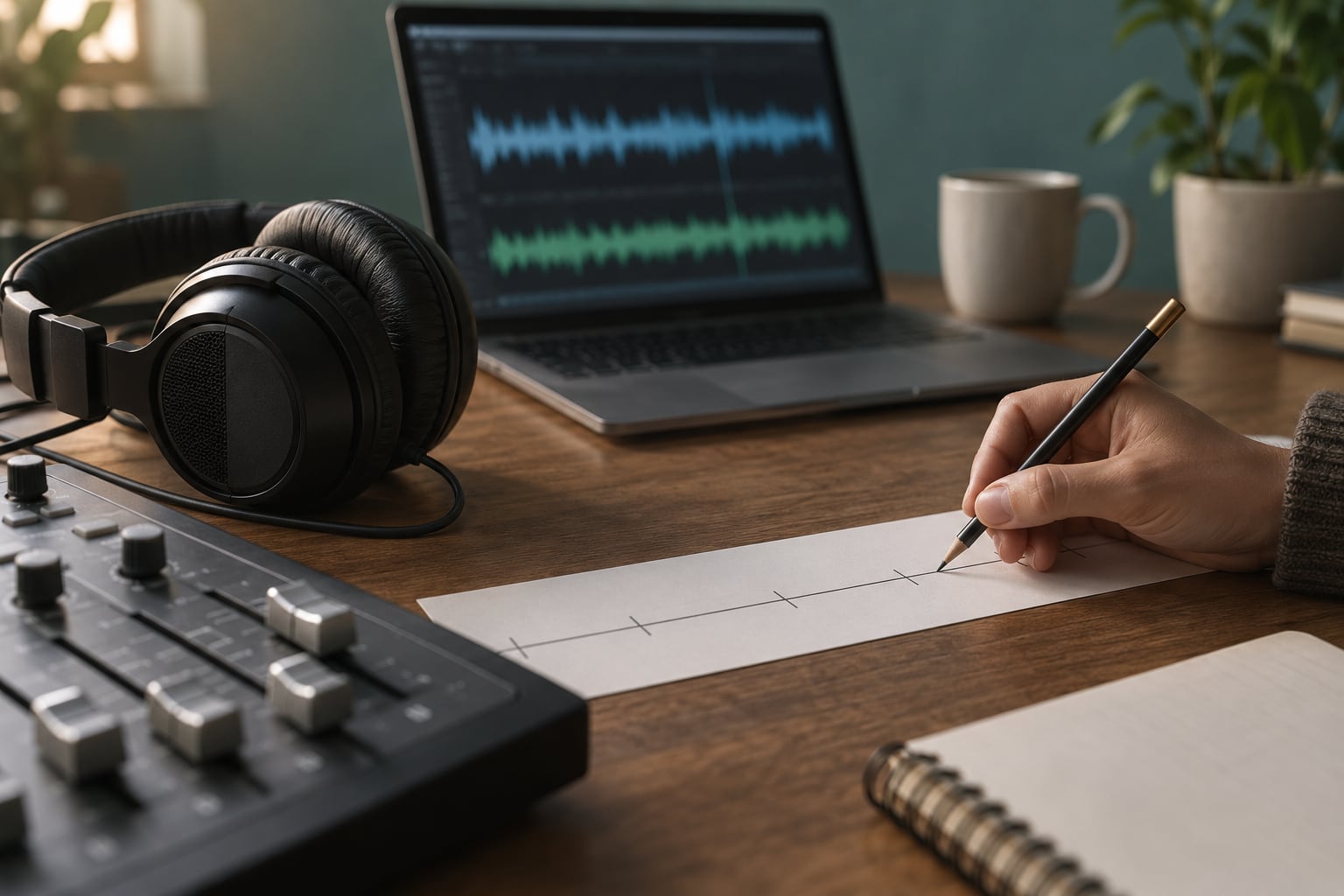
Separate audio stems with AI: inspect leakage, artefacts and editability
An isolated voice is not a new studio recording. Separation tools such as LALAL.AI and Moises extract elements from a mixture; useful quality depends on listening and the final edit.

The method to apply
Keep the original, choose authorised audio and define the target stem. Compare equally loud exports, then inspect pauses, attacks, consonants and reverberation. Separation creates no additional rights in the work.
- Isolation
- Fidelity
- Synchronisation
- Reuse
Prepare, test and decide
1. Define use
Practice, analysis and publication require different acceptance thresholds. Define duration, format and blocking defects before separation.
2. Keep a reference
Work on an authorised copy and record sample rate, duration and version. Avoid evaluating outputs against a differently compressed original.
3. Select a target
Separate vocals or one identified instrument instead of accumulating treatments without a purpose. Keep separation type and available settings.
4. Listen to difficult passages
Inspect overlapping sounds, note attacks, consonants and reverb tails. Listen to the isolated stem and residue; useful sound may have moved into the wrong output.
5. Test in final context
Reinsert the stem into the edit or practice session. Solo defects may be acceptable in one context and blocking in another. Check alignment and file start.
6. Keep an explainable decision
Record leakage, artefacts, corrections and human time. Keep the original or rerecord when separation destroys essential information.
Examine profiles related to this method
Put the method to work
Practical case
With authorised audio, compare an isolated voice and accompaniment at three difficult passages.
Evidence to keep
Keep original, stems, settings, time markers and listening notes.
Make the decision
Accept according to final context and rights; do not assign universal ratings from one excerpt.
Acceptance criteria
Isolation
The target remains present and leakage is known.
Fidelity
Attacks and articulation remain intelligible.
Synchronisation
Exports align in the edit.
Reuse
Rights and formats suit the use.
Profiles related to this method
Suggested tools belong to relevant families; order is not a performance benchmark.

ElevenLabs
speech synthesis
ElevenLabs · US
Visit official site
Suno
music composition
Suno · US
Visit official site
Udio
music composition
Udio · US
Visit official site
Wondercraft
audio production studio
Wondercraft · GB
Visit official site
AIVA
music composition
Aiva Technologies · LU
Visit official site
SOUNDRAW
music composition
SOUNDRAW · JP
Visit official siteHow is this selection produced?
Active services are distributed across guide-related categories, then ordered by editorial highlighting and internal score. This does not assess security, compliance or performance on your use case. Methodology.
Explore tools for this task
- Murf — Produce controlled narration for educational material or a demonstration.
- LALAL.AI — Prepare isolated stems for authorised analysis or editing.
- Moises — Prepare a practice session or analyse authorised music.
- AIVA — Prepare a musical draft and work on arrangement and export.
- SOUNDRAW — Find a musical base suited to a defined duration and mood.
- Cleanvoice — Prepare an initial podcast cleanup before editorial listening.
Related tool families
Frequently asked questions
Must all artefacts be eliminated?
The threshold depends on use. Practice stems and solo published narration have different requirements.
Does separation permit publishing a song?
No. Check rights applying to the work, recording and intended use.
The references below expand on the concepts and checks discussed. Scenarios and trial frameworks remain editorial proposals; provider documentation describes its own product rather than an independent benchmark.